- From: 陳信屹 <tyson@slashlife.ai>
- Date: Mon, 1 Dec 2025 09:37:51 +0800
- To: Milton Ponson <rwiciamsd@gmail.com>
- Cc: paoladimaio10@googlemail.com, W3C AIKR CG <public-aikr@w3.org>
- Message-ID: <CAGRPLTNHh1DXk2kx4fHG3Efuhd=Wp=QXGAWQ6fAkJAF2_NFdVA@mail.gmail.com>
Hi Paola, Milton, and all

Thanks.

To be precise, I should not use "above/sit" but use "between".

AgentIDL does not replace KR (from Paola's definition) or mathematical
foundations (from Milton's view) ; it introduces a third operational layer
between them.

In my view, the knowledge of humans can be constructed mathematically and
also constructed through KR(Paola's lineage), each capturing different
domains: mathematics provides tests for representability and constructive
validity, while KR carries the mappings related to social context, cultural
choices, institutional constraints, and value-laden interpretations.
AgentIDL builds *on top of both* by defining how these structures become
executable, auditable, and behaviourally constrained.

This operational layer specifies how agents enact obligations defined in
KR, using a type system, prompt-level operational semantics, and workflow
calculus. It enables a transition from descriptive semantics to computable
behaviour without collapsing the distinctions between mathematical
structure, social meaning, and runtime execution.

Gödel’s incompleteness ensures that no formal system can fully eliminate
human oversight; therefore, human-in-the-loop remains structurally required
when KR intersects real-world norms and institutional decision-making.

In short, HoTT’s constructive semantics allow AgentIDL to bridge linguistic
uncertainty and mathematical incompleteness, enabling agents to remain
executable, auditable, and aligned with user intent and governance
constraints. (I won't go further since this is not related to this CG.

In this framing, AgentIDL does not sit “above” KR; it connects mathematical
constructability and KR-level meaning with executable semantics, forming a
coherent pipeline from conceptual representation to verifiable agent
behaviour.

For the references of my engineering context, here is the lineages I am
trying to map for describing where the concepts of AgentIDL from:

https://figshare.com/articles/preprint/Untitled_CollectionA_Unified_Lineage_for_Auditable_Agency_From_Generative_Constraints_to_Semantic_Execution_Environments/30744368?file=59971073

and here is the version for mapping OS-level concepts, which I called
semantic OS (highly related to old tech works in w3c's semantic web).

https://figshare.com/articles/preprint/Lineage_Mapping_for_the_Semantic_Operating_System/30744260?file=59970956

thx.

Milton Ponson <rwiciamsd@gmail.com> 於 2025年11月29日週六 下午12:49寫道:

> Again I must challenge that nothing sits above knowledge representation
> for AI,  because knowledge can be represented mathematically before it is
> represented for computational purposes, i.e. in KR for AI as defined in the
> AIKR CG.
> In defining KR for AI you unknowingly are equating knowledge
> representation with information representation. All the concepts and
> conceptual layers are information based.
> This invisible jump is from the descriptive set theoretic level to the
> representable set theoretic level and in this jump causality,  the axiom of
> choice and representability are assumed.
>
> Milton Ponson
> Rainbow Warriors Core Foundation
> CIAMSD Institute-ICT4D Program
> +2977459312
> PO Box 1154, Oranjestad
> Aruba, Dutch Caribbean
>
> On Fri, Nov 28, 2025, 22:24 陳信屹 <tyson@slashlife.ai> wrote:
>
>> Hi
>>
>> For my agentic-execution interface specification, the relevant layer sits
>> above KR and below agent behavior: this is a Semantic Execution Layer,
>> where ontic categories become executable, auditable constraints for agents.
>>
>> My engineering model is:
>>
>> Ontology → Semantic Execution Layer → Agent Runtime → OS → TCP/IP or UDP
>> → Hardware Devices/Network protocol 。
>>
>> In this architecture, ontology functions as institutional structure,
>> while the execution layer determines how those structures are enacted by
>> agents.
>>
>> The Semantic Execution Layer is the architectural stratum that transforms
>> ontic or institutional structures into executable, auditable behavioral
>> constraints for agents.
>>
>> It operates above knowledge-representation formalisms and below agent
>> runtime systems, serving as the mechanism through which semantic
>> categories, roles, capabilities, and commitments are enacted as operational
>> rules within an agentic computing environment.
>>
>> Thx
>>
>> Paola Di Maio <paola.dimaio@gmail.com>於 2025年11月28日 週五,下午6:49寫道:
>>
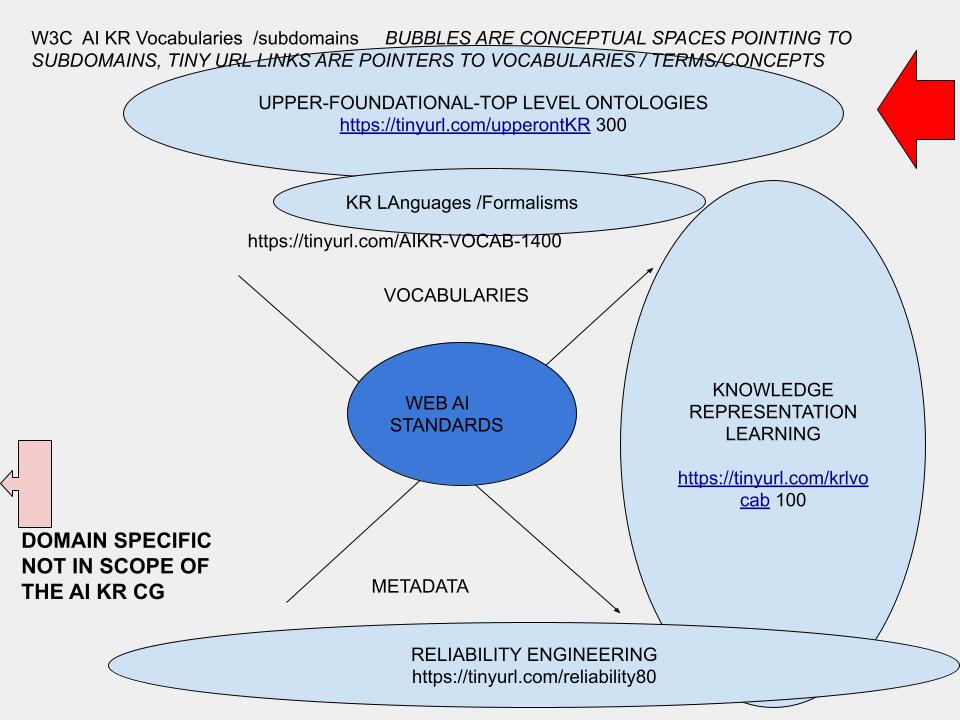
>>> Thinking of where would Tyson's agentic execution interface
>>> specification would sit in the diagram, *presumably in the  KR
>>> Language/Formalism bubble?
>>> I have extracted  captured in a table and a list of terms most ontic
>>> categories, which is going to be our first deliverable,
>>> please give feedback, help to improve/expand.
>>>
>>> Please request access to view
>>>
>>> https://docs.google.com/document/d/1OyZGVDCMozbAGPaKqYpUnWX75raGoCNpd6KJN3bMoFQ/edit?usp=sharing
>>>
>>> [image: AI KR VOCABS NOV 2025 upper ont.jpg]
>>>
>>>
>>>
>>> Please request access if you would like to give feedback
>>>
>>
Attachments
- image/jpeg attachment: AI_KR_VOCABS_NOV_2025_upper_ont.jpg
Received on Monday, 1 December 2025 01:38:08 UTC